
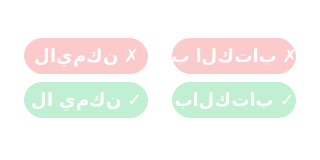
Arabic writing has a category of words that are grammatically separate, but in practice many writers merge them incorrectly, and others that look like they should be separate but are in fact always written as one unit. The confusion is real, and it shows up in formal documents, social media posts, and student essays alike. This guide covers the cases that trip people up most often.
Category 1: Clitics That Always Attach (Always Merge)
These are single-letter particles that have no independent written form. They always attach directly to the word that follows.
| Particle | Function | ❌ Wrong | ✅ Correct |
|---|---|---|---|
| بـ | Preposition "by / with / in" | ب الكتاب | بالكتاب |
| لـ | Preposition "for / to" | ل الطالب | للطالب |
| كـ | Comparison "like / as" | ك الأسد | كالأسد |
| فـ | Conjunction "so / and then" | ف ذهب | فذهب |
| وـ | Conjunction "and" | و الكتاب | والكتاب |
Category 2: Words That Always Stay Separate
These are frequently merged incorrectly, especially in fast typing.
| ❌ Wrong (merged) | ✅ Correct (separate) | Rule |
|---|---|---|
| لاأعرف | لا أعرف | لا is always a separate word |
| منالبيت | من البيت | من is always a separate word |
| عنالموضوع | عن الموضوع | عن is always a separate word |
| إلىالمدرسة | إلى المدرسة | إلى is always a separate word |
| هلتعرف | هل تعرف | هل is always a separate word |
| قدكتب | قد كتب | قد is always a separate word |
Category 3: The Tricky In-Between Cases
These are the most confusing cases because the same word behaves differently depending on meaning or grammatical context.
ما: separate or merged?
| Form | Meaning | Written |
|---|---|---|
| Interrogative ما | What? / What is? | ما هذا؟ (separate) |
| Negating ما | He did not write | ما كتب (separate) |
| مِمَّا (من + ما) | from what | مما (merged) |
| ماذا (ما + ذا) | What? | ماذا (merged) |
| كلما (كل + ما) | Whenever / Every time | كلما (merged) |
| إنما (إن + ما) | Only / But rather | إنما (merged) |
أن / إن + ما
| Form | Meaning | Written |
|---|---|---|
| أنما | Only (emphasis) | أنما (merged) |
| أن ما | That which / that what | أن ما (separate) |
| إنما | Only / Surely | إنما (merged) |
| إن ما | If what | إن ما (separate) |
Category 4: Genuine Compound Nouns
Some Arabic compound nouns are made from two words that have fused into a single meaning. These are always written as one unit.
| Compound | Components | Meaning |
|---|---|---|
| بسملة | بسم + الله | The phrase "In the name of God" |
| حوقلة | لا حول + ولا قوة + إلا بالله | The phrase "There is no power except God" |
| حيعلة | حي + على | The call "Come to..." |
Common Mistakes in Formal Writing
| ❌ Wrong | ✅ Correct | Mistake type |
|---|---|---|
| لايمكن | لا يمكن | لا merged with verb |
| ب سبب | بسبب | بـ written separately |
| وأيضا | وأيضاً | Missing tanween fath on adverb |
| لكن لا | لكن لا (✓ this is correct) | لكن and لا are always separate |
| حتىالآن | حتى الآن | حتى merged with following word |
Frequently Asked Questions
Is it wrong to merge لا with the following word?
Yes. لا is always a separate word in Arabic: «لا أعرف»، «لا وقت». Never write «لاأعرف». The only exception is the word لا in negative compound constructions like «لاسيما» which is a fixed merged expression meaning "especially".
Why do some prepositions merge with the word after them?
Short particles like بـ، لـ، كـ are clitics, they have no independent written existence and always attach to the following word. Longer prepositions like على، إلى، عن always stay separate.