
Unlike English, where "the" works for everything and gender only matters for a handful of pronouns, Arabic grammatical gender is everywhere. Every noun, pronoun, adjective, and verb carries gender. Get it wrong and the sentence falls apart, or worse, becomes accidentally funny. This guide gives you the rules, the patterns, and the exceptions you need to get gender right consistently.
How Arabic Gender Works
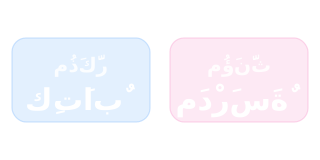
Every Arabic noun is either masculine (مُذَكَّر) or feminine (مُؤَنَّث). There is no neutral gender. This is not about biology, the word شَمْس (sun) is feminine and قَمَر (moon) is masculine, purely by grammatical convention. Gender must be memorised for many words, but strong patterns cover the majority of cases.
Masculine (مُذَكَّر)
- كِتَاب, book
- بَيْت, house
- قَمَر, moon
- بَاب, door
- رَجُل, man
Feminine (مُؤَنَّث)
- مَدْرَسَة, school
- شَمْس, sun
- مَدِينَة, city
- طَاوِلَة, table
- اِمْرَأَة, woman
How to Identify a Feminine Noun
While gender must sometimes simply be memorised, three clear markers signal feminine nouns in the vast majority of cases.
Marker 1: Taa Marbuta (ة)
The most reliable signal. Almost every noun ending in ة is feminine: مَدْرَسَة (school), طَالِبَة (female student), سَيَّارَة (car). This is why correctly writing ة versus ه matters so much, confusing them does not just create a spelling error, it changes the gender of the word. Our spelling guide covers the taa marbuta vs haa distinction in detail.
Marker 2: Alef Maqsura or Alef Mamduda ending
Many feminine nouns end in ى or اء: صَحْرَاء (desert, f.), سَمَاء (sky, f.), ذِكْرَى (memory, f.). These endings are a strong but not absolute indicator of feminine gender.
Marker 3: Natural gender
Nouns referring to female humans and animals are grammatically feminine regardless of their ending: أُم (mother), أُخْت (sister), نَاقَة (she-camel).
Gender Agreement: The Four Rules
Once you know a noun's gender, every element that modifies or refers to it must agree. This is called المطابقة (agreement), and it operates on four levels.
Rule 1: Adjective Agreement
Adjectives follow the noun and match its gender. Masculine adjectives have no suffix; feminine adjectives add ة.
| Masculine | Feminine | Meaning |
|---|---|---|
| كِتَابٌ كَبِيرٌ | مَدْرَسَةٌ كَبِيرَةٌ | big book / big school |
| طَالِبٌ مُجْتَهِدٌ | طَالِبَةٌ مُجْتَهِدَةٌ | diligent student (m/f) |
| بَيْتٌ جَمِيلٌ | سَيَّارَةٌ جَمِيلَةٌ | beautiful house / beautiful car |
Rule 2: Verb Agreement
When the verb comes before the subject, it agrees in gender but not necessarily in number (a rule unique to verb-initial sentences). When it follows the subject, full agreement applies. This connects directly to the patterns covered in our verb conjugation guide.
| Masculine subject | Feminine subject |
|---|---|
| كَتَبَ الطَّالِبُ | كَتَبَتِ الطَّالِبَةُ |
| يَدْرُسُ الوَلَدُ | تَدْرُسُ البِنْتُ |
Rule 3: Pronoun Agreement
Pronouns must match the gender of the noun they replace: هو (he/it m.) → هي (she/it f.). Using the wrong pronoun is one of the most jarring errors in Arabic.
Rule 4: Demonstrative Agreement
Demonstratives also agree in gender: هذا (this, m.) / هذه (this, f.), and confusing them is one of the most common spelling mistakes we list in our top 10 errors guide.
| Masculine | Feminine |
|---|---|
| هذا الكِتَاب | هذه المَدْرَسَة |
| ذلك البَيْت | تلك السَّيَّارَة |
Tricky Exceptions to Know
| Word | Apparent gender | Actual gender | Notes |
|---|---|---|---|
| شَمْس (sun) | Ends in plain س → looks masculine | مؤنث | Conventionally feminine, must be memorised |
| أَرْض (earth) | Plain ending | مؤنث | Feminine by convention |
| خَلِيفَة (caliph) | Ends in ة → looks feminine | مُذَكَّر | Masculine despite ة, a rare exception |
| حَرْب (war) | Plain ending | مؤنث | One of many feminine nouns with no marker |
| نَار (fire) | Plain ending | مؤنث | Feminine, often surprises learners |
Non-rational Plural: The Feminine Trap
This is one of the most counterintuitive rules in Arabic grammar: plural nouns referring to non-rational beings (animals, objects) are treated as grammatically feminine singular for the purposes of agreement, even if the singular noun was masculine.
Common Mistakes in Gender Agreement
| ❌ Wrong | ✅ Correct | Issue |
|---|---|---|
| هذا المدرسة | هذه المدرسة | Masculine demonstrative with feminine noun |
| الطالبة المجتهد | الطالبة المجتهدة | Masculine adjective with feminine noun |
| الكتب الجميل | الكتب الجميلة | Non-rational plural needs feminine adjective |
| السيد [female name] | السيدة [female name] | Wrong gender title in formal address |
Frequently Asked Questions
Does every Arabic noun have a fixed gender?
Yes, every Arabic noun is either masculine or feminine. There is no neutral gender. A small number of nouns (called المُشْتَرَك اللَّفْظِي) can be used as either gender without changing form, but these are exceptions.
How do I know the gender of a noun I have not seen before?
Check for the taa marbuta ة, if it is there, the noun is almost certainly feminine. Otherwise, look it up in a dictionary. The Arabic correction tool will also flag gender agreement errors if you are unsure whether your usage is correct.