
Arabic speakers write billions of words online every day, across Twitter/X, Instagram, TikTok, LinkedIn, and WhatsApp. The speed and informality of these platforms has created a written Arabic that is looser, faster, and more error-prone than any previous generation of written communication. Some of these errors are harmless stylistic choices. Others, especially on professional or public accounts, quietly damage credibility with every post. This guide covers the ones that matter.
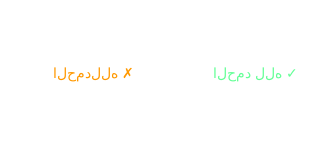
Mistake 1: الحمدلله vs. الحمد لله
This is the single most typed phrase in Arabic social media, and the most commonly misspelled. الحمدلله is one of the most searched Arabic correction queries worldwide.
Two errors in one sentence: الحمد لله must be two separate words (the tanween on الحمد requires a space before the following word), and شيء (something) is not شئ. This word is covered in our spelling guide, the hamza of شيء sits on a yaa chair and cannot be replaced with a standalone hamza above an alef.
Mistake 2: ة vs. ه at the End of Words
One of the most widespread errors in all Arabic digital writing. On a phone keyboard, ة and ه are adjacent, and many writers either mistype them or, especially on devices with Arabic autocorrect issues, end up posting with the wrong letter.
| ❌ Wrong | ✅ Correct |
|---|---|
| الجامعه كبيره | الجامعة كبيرة |
| السياره الجديده | السيارة الجديدة |
| هذه المدرسه | هذه المدرسة |
Beyond being a spelling error, replacing ة with ه changes the grammatical gender of the noun. A word that loses its ة is no longer reliably feminine, which cascades into adjective and verb agreement errors in the same sentence. Our dedicated article on masculine and feminine in Arabic explains exactly why this matters.
Mistake 3: Missing Hamza in Common Words
Hamza is systematically omitted in online Arabic. The cognitive effort of selecting the right seat (أ إ ئ ؤ ء) is real, and many writers simply skip it. On professional accounts, this reads as carelessness.
Every underlined word has a missing hamza: عصيرًا ،أكلنا، أعتقد، أنه. The complete guide to Arabic hamza on this blog covers the rules for every context, including why أكل starts with hamza qata' while اكتب starts with hamza wasl.
Mistake 4: Dropping the Final Alef from Plural Verbs
كتبوا (they wrote) must end with a silent alef. Online, this alef is almost universally dropped, كتبوا becomes كتبو, نشروا becomes نشرو. It looks like a trivial detail but it is one of the clearest markers of writing carefulness.
Mistake 5: Mixing English Punctuation with Arabic Text
Arabic uses its own question mark (؟) and comma (،), mirrored versions that match the right-to-left direction of the text. Writing Arabic questions with a Western question mark (?) and using a Western comma (,) instead of the Arabic comma (،) is extremely common on social media. On professional accounts, it is worth the extra effort to use the correct marks.
| ❌ Wrong | ✅ Correct | Mark |
|---|---|---|
| كيف حالك? | كيف حالك؟ | Question mark |
| الكتاب, القلم, الدفتر | الكتاب، القلم، الدفتر | Comma |
The full rules for Arabic punctuation, including which marks have no Arabic equivalent and must use the Western form, are in our Arabic punctuation guide.
Mistake 6: Arabised Slang That Creeps into Formal Posts
Platform-specific Arabic slang has exploded in recent years: أوك، سوري، تمام تمام، هاشتاق، ريتويت. These are fine in casual posts and private messages. But they look jarring in professional announcements, business profiles, or opinion pieces that aim for credibility. If you want your Arabic writing to be taken seriously, develop an awareness of when register matters, and when it does not. Our guide on how to improve your Arabic writing style addresses register in depth.
Mistake 7: هاذا instead of هذا
The demonstrative هذا (this) is routinely written as هاذا on social media, adding a spurious alef that does not belong. The same error appears as هاذه for هذه and هاذان for هذان. This is one of the most searched Arabic spelling questions.
Does Any of This Actually Matter?
The honest answer: it depends on context and audience. In a casual WhatsApp group, nobody cares about the alef at the end of كتبوا. But on a public Instagram account, a professional LinkedIn post, or a Twitter thread that people screenshot and share, errors accumulate into an impression. They are not fatal, but they are noticed by educated readers. For anyone building a personal brand, representing a business, or writing content that aims to be taken seriously: these ten minutes of checking are worth it. Paste your draft into our Arabic smart error checker before posting. It is faster than going back to edit a post after the comments have arrived.
Frequently Asked Questions
Is it wrong to write in dialect (عامية) on social media?
No, dialect is a legitimate and natural choice for casual social content, especially when targeting a specific regional audience. The errors listed above are not about dialect vs. فصحى, they are spelling and grammatical errors that occur in both registers.
Why do Arabic phones often autocorrect incorrectly?
Arabic autocorrect systems are trained on frequency, and because errors like dropping the alef in كتبوا are so common, some keyboards have "learned" the incorrect spelling. Always review before posting, especially on the phone.
What is the fastest way to check a social media post in Arabic?
Copy the text, paste it into our tool that corrects Arabic and explains each rule, and run the Correction. The corrections appear with explanations, so you learn the rule at the same time as fixing the error.